How Donor Human Milk Saved Amara’s Life

Baby Amara is a miracle in more ways than one. Her mother, Steph, was diagnosed with cervical cancer when she was 22. After ten years of treatment, she finally had a clear scan, and immediately knew she wanted to be a mom. After years of fertility treatment, her dream came true: she was pregnant. Unfortunately, the joy she was experiencing was overshadowed by fear.

As Steph got further along in her pregnancy, she was hospitalized for preeclampsia and HELLP syndrome, a life-threatening complication that was causing extra stress on Steph’s liver. Her doctor ordered an ultrasound. But instead of feeling relief that her baby was healthy, Steph received terrifying news: Amara had only developed one kidney.

While Steph was in the hospital, her care team’s goal was to get Amara as close to full term as possible, a challenging feat given Steph’s condition. After a blood draw was too painful for her to tolerate, and doctors worried her liver was failing, Steph was rushed in for an emergency C-Section. It was time for Amara to make her grand entrance.

Amara was born ten weeks early with jaundice, a club foot, and only one working kidney. They immediately admitted her to the NICU and started genetic testing to find out what caused her condition. In the meantime, Steph was struggling to establish her milk supply. The medications she had to take made it impossible to produce enough to feed her baby. On top of that, specialty formulas for babies with kidney issues were unavailable because of the nationwide formula shortage.

“I didn’t know how she would eat,” Steph said.

But luckily, her care team had a solution: they started feeding Amara donor human milk from Mothers’ Milk Bank. Receiving the gift of donor human milk for her baby gave Steph a sense of relief that Amara would have a better chance at survival.

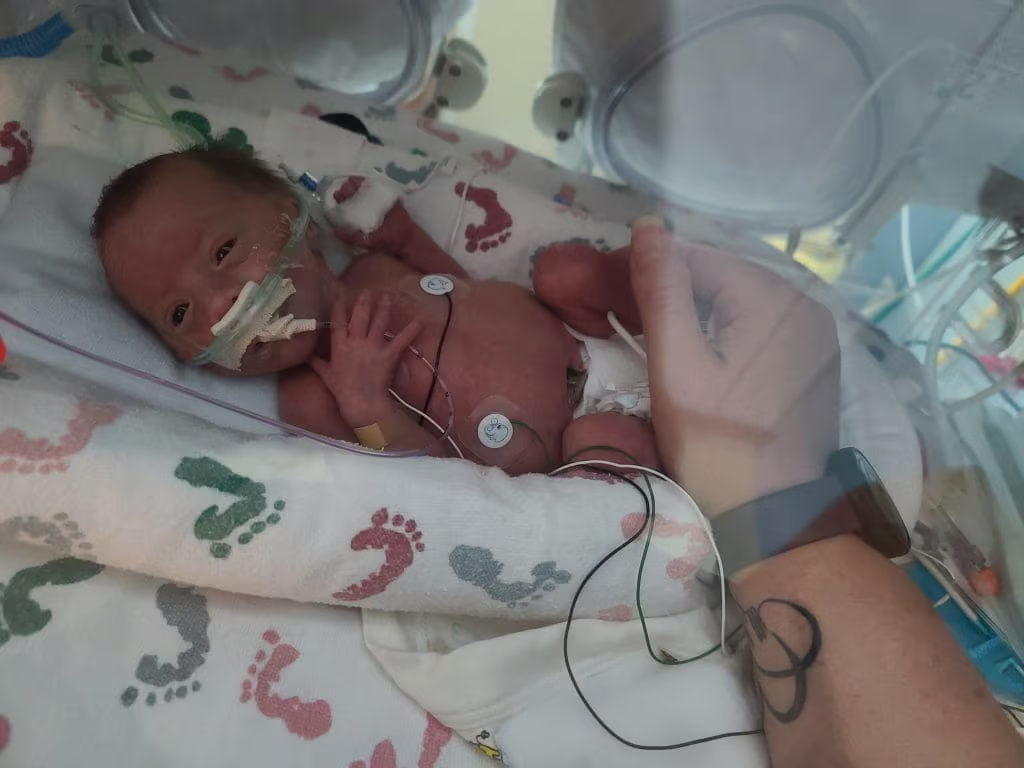
Amara being held by her mother Steph. Amara needed Donor Human Milk in the Hospital and at home.

When it was time to leave, Steph worried about feeding Amara at home. She knew she had access to donor milk in the hospital but wasn’t sure if she could get it at home. She asked her doctor how she would feed her baby, and he gave her the good news: because of our community of supporters, Mothers’ Milk Bank could provide Steph with the precious milk Amara needed to thrive. Finally, after months of pregnancy, delivery, and NICU stress, Steph felt relieved. She could now focus on settling into motherhood.

Donor human milk is a critical source of nutrition for premature and sick babies like Amara. Its life-saving properties make donor human milk the first choice for babies when their parents’ own milk is unavailable. At Mothers’ Milk Bank we rely on generous milk donations from new parents looking to help other families. Selfless milk donors and financial supporters help us provide critical nourishment to thousands of babies every year.

“The donors made a huge difference for me, and I am so grateful,” Steph shares. Thanks in part to their generosity and selflessness, Amara is happily back home and thriving. As Steph lovingly says, “She is the rest of me.”

“I felt helpless, like I didn’t know what to do. Having donor human milk has been such a huge relief.” — Sarah, the Triplets’ Mother

For many years, Sarah and her husband, Sawyer, dreamed of having kids. After multiple miscarriages and an ectopic pregnancy, the couple were overjoyed to learn they had successfully conceived triplets through IVF. But when Sarah’s water broke at just 33 weeks, they soon found their family facing a difficult journey.

As Sarah was rushed to the hospital for an emergency C-section, she was losing blood quickly. By the time she delivered babies Ethan, Sam, and Penelope, she had lost almost half the volume of her blood. While she recovered from delivery and patiently waited for her milk to come in, the triplets were admitted to the hospital’s Neonatal Intensive Care Unit (NICU). There, the trio received the life-saving donor human milk they so desperately needed.

Sarah holding her babies. All three of her triplets needed donor human milk at home and in the hospital.

Despite being born at just above three pounds, Sam only spent the first few weeks of life in the NICU, alongside sister Penelope. For the third triplet, Ethan, life in the NICU wasn’t so brief. Early on, he was diagnosed with respiratory distress syndrome, a common condition for premature babies. Since his lungs were not fully developed, he could not breathe on his own and he had to be put on a ventilator to keep him alive.

“From the beginning, you’re always thinking about bringing home three babies, but watching him struggle so much, you start wondering if he is actually going to make it home.”


After over 50 days of fighting, Ethan was able to go home. Now, three months after leaving the NICU, Ethan still requires support from an oxygen tank (which Sarah lovingly likens to having a fourth baby to carry around).

Once their family was back home, Sarah found herself struggling to supply enough milk to meet the needs of all three babies. She found her stash of frozen breastmilk dwindling when two of her little ones developed dairy and soy sensitivities, meaning Sarah needed to switch to a specialized diet. The triplets weren’t getting the calories they needed to gain weight appropriately. As Sarah says: “There’s nothing worse than having a hungry baby who can’t eat.”

In their time of need, financial donors were there when it counted – making it possible for Rocky Mountain Children’s Health Foundation to provide precious donor human milk to babies like Ethan, Sam, and Penelope through Mothers’ Milk Bank. Thanks to your support, Sarah had the liquid gold she needed to feed her babies.

“Mothers’ Milk Bank has taken a huge weight off my shoulders, and just seeing my babies eat well makes me choke up.”

Sarah’s family is not alone. Courageous families across the country are navigating the incredible pressures of premature or critically ill newborns.

Help us support families like Sarah’s by giving a gift in the link below. Your contribution will help us do everything possible to keep our most vulnerable populations healthy and thriving. Together, we can be there for these courageous families when it really counts.